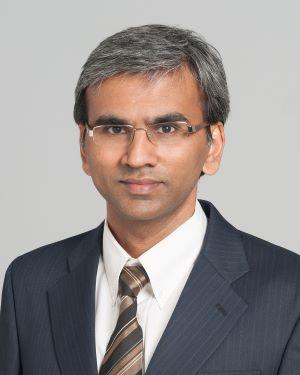
Raghavan Gopalakrishnan, PhD
Associate Staff
Joint Staff, Biomedical Engineering
Assistant Professor, Biomedical Engineering, CCLCM
Email: [email protected]
Location: Cleveland Clinic Main Campus
Research
Dr. Gopalakrishnan’s research focuses on understanding brain rhythms using neurophysiological approaches, including magnetoencephalography (MEG), electroencephalography (EEG) and local field potentials, with the goal of developing objective biomarkers and novel therapeutic strategies for neurological and mental health conditions. His work integrates computational modeling with neurophysiology to identify dynamic neural mechanisms underlying pain, fear, anxiety, expectation and avoidance. His research program also emphasizes translational neurophysiology, with a long-term goal of developing personalized approaches using non-invasive brain stimulation techniques to improve outcomes for patients with chronic pain and related disorders.
Biography
Dr. Raghavan Gopalakrishnan is a neurophysiologist and biomedical engineer whose research focuses on understanding how dynamic brain rhythms encode sensory, cognitive, affective and behavioral processes in health and disease. He is an Associate Research Staff member in the Center for Neurological Restoration at Cleveland Clinic, with a joint appointment in Biomedical Engineering in Cleveland Clinic Research and an academic appointment at Cleveland Clinic Lerner College of Medicine. He is also an adjunct professor at Cleveland State University.
Dr. Gopalakrishnan's research program integrates magnetoencephalography (MEG), electroencephalography (EEG), intracranial/local field potential recordings, computational modeling and quantitative behavioral approaches to characterize the neural dynamics underlying complex human behavior. His work is particularly focused on identifying how oscillatory brain activity evolves over time and how these dynamics relate to latent cognitive and affective processes, including pain anticipation, threat and avoidance learning, expectations and prediction errors.
Dr. Gopalakrishnan has published extensively in the areas of MEG, neural oscillations, pain neurophysiology and neuromodulation. His overarching research vision is to develop quantitative, mechanistically informed neurophysiological tools that can improve diagnosis, predict clinical trajectories and enable personalized interventions for patients with chronic pain and other disorders of brain function.
Education & Professional Highlights
Education
Graduate Education – Cleveland State University
Doctor of Engineering (DEng), Applied Biomedical Engineering
Cleveland, OH USA
2015
Graduate Education – Cleveland State University
MBA, Healthcare
Cleveland, OH USA
2011
Graduate Education – University of Akron
Master of Science (MS), Biomedical Engineering
Akron, OH USA
2004
Undergraduate Education – University of Madras
Bachelor of Engineering (BE), Instrumentation and Control
Control Chennai, India
2002
Memberships
- Member, Society for Neuroscience (SfN)
- Member, International Association for the Study of Pain (IASP)
Research
Research Overview
The Gopalakrishnan Lab focuses on understanding brain rhythms using neurophysiological approaches, including magnetoencephalography (MEG), electroencephalography (EEG) and local field potentials, with the goal of developing objective brain-based biomarkers and novel therapeutic strategies for neurological and mental health conditions. The lab has four main areas of focus: 1. Mechanistic: elucidate neural mechanisms 2. Translational: biomarkers 3. Interventional: neuromodulation 4. Personalized medicine: multimodal treatment strategies
Computational neurophysiology of pain avoidance
Moving beyond "which brain regions are active in pain," we ask how expectations, prediction errors and decisions are encoded by oscillatory brain dynamics, and how they interact to produce pain-avoidance behavior. We use computationally derived latent variables as regressors on MEG data. Our work has demonstrated that aversive prediction errors – arising when painful or non-painful outcomes violate expectations – are rapidly encoded within alpha-band activity across midbrain, orbitofrontal and prefrontal regions, while prefrontal alpha dynamics contribute to subsequent avoidance decisions. This work establishes a mechanistic framework for understanding how adaptive pain avoidance may become dysregulated in chronic pain and provides a foundation for identifying neurophysiological biomarkers of maladaptive pain-related learning. We are currently studying avoidance behavior in nociplastic pain syndromes such as chronic regional pain syndrome (CRPS), specifically, factors that mediate avoidance including demographics, brain oscillations, traits and clinical symptoms. Another outstanding question we are seeking to answer is the relationship between avoidance and risk for opioid use disorder.
Role of avoidance behavior in migraine treatment failure
Calcitonin gene-related peptide targeted monoclonal antibodies (mAbs), a new class of migraine preventive drugs, are promising but expensive with a high failure rate. Growing evidence indicates maladaptive traits and behaviors may have a mediating role in mAb treatment failure and could lead to refractory migraine. Specifically, avoidance behavior orchestrated by pain-related negative affect could exacerbate trigeminal system excitability, leading to central sensitization that likely attenuates the prophylactic effects of mAbs. Although avoidance has occupied a central role in migraine for decades, its behavioral and neurobiological underpinnings in mAb treatment failure and migraine in general are still unclear. We leverage computational neurophysiology to investigate the link between pain avoidance and mAb treatment failure, which could reveal key insights for strategies to improve clinical outcomes.
Modulation of pain behaviors using non-invasive brain stimulation
The overarching goal of this project is to gain mechanistic insights into the brain–behavior relationship underlying pain avoidance behavior and its modulation using alpha-frequency transcranial alternating current stimulation (tACS) targeting the prefrontal cortex (PFC). While adaptive avoidance of pain aids in survival, maladaptive pain avoidance plays a key role in the development and maintenance of chronic pain hampering physical therapy and rehabilitation, especially in conditions like CRPS with a high burden of psychopathology. Although much of the impairment is attributed to the dysfunction and disinhibition involving the PFC networks, the underlying neurophysiology and its causal relationship with pain avoidance behavior is yet to be determined. We take a multimodal approach to study how behavior, brain neurophysiology and autonomic nervous system (ANS) responses are modulated by enhancing the alpha oscillatory power in the PFC. Given the alpha oscillations in the PFC facilitate inhibitory processes required for decision making and learning, we hypothesize that enhancing alpha power via tACS will promote adaptive pain avoidance behavior in CRPS patients.
Neurophysiology underlying ocular surface pain and photoallodynia
Chronic ocular surface pain (COSP) is a debilitating pain condition in the eye that often persists after resolution of the initial insult, with features resembling both nociplastic and neuropathic pain. The diagnosis of COSP is extremely challenging due to its overlapping symptoms with dry eye disease or lack of any clinical signs of the disease. Photoallodynia, a disabling painful sensitivity to light, is a common feature across many conditions including COSP, migraine and traumatic brain injury. The diagnosis of COSP and photoallodynia is based on questionnaires and patient-reported pain symptoms, and an ocular surface examination to rule out other causes, with no objective tests currently available. The goal of this project is to explore the neurophysiological biomarkers of COSP and photoallodynia using magnetoencephalography (MEG), which offers an opportunity to study large-scale brain dynamics with whole-brain coverage. This project will provide critical preliminary data for objective diagnosis, patient stratification and treatment monitoring.
Effects of ketamine on brain rhythms
Fear extinction and associative relearning have shown to be positively impacted by ketamine, an N-methyl-D-aspartate (NMDA) antagonist, in research studies on various psychiatric disorders including depression, bipolar disorder and obsessive compulsive disorder. NMDA receptors play an important role in nociceptive signaling. Ketamine can noncompetitively inhibit these receptors, which has created interest in using this drug to treat chronic pain. While ketamine’s short-term, analgesic effects hold promise, its utility in enhancing long-term, plastic changes facilitating fear extinction and relearning in chronic pain is still largely untested. This study addresses the question of whether ketamine can modulate pain avoidance and promote fear extinction learning in persons with chronic pain. Further, the study explores neurophysiological correlates of ketamine on fear extinction learning by conducting a fear-conditioning task in the MEG scanner. Computationally derived latent behavioral regressors will be used to localize brain areas involved in fear extinction learning.
Neurophysiological mechanisms underlying locomotor learning in knee osteoarthritis
Pain is a prevalent, multidimensional symptom of knee osteoarthritis (OA) that could impair locomotor learning and retention through its effect on the neural motor network. OA-related knee pain can include physical, psychological, emotional and neuroplastic component;, however, the neural mechanisms underpinning impaired locomotor learning in adults with knee OA remain elusive. Collaborating with Dr. Patrick Corrigan’s lab, we examine neuroplastic consequences of OA-related knee pain (e.g., decreased activity in motor and prefrontal cortices) and its influence on locomotor learning and retention.
Key Collaborators
- Pavan Tankha, DO, Comprehensive Pain Recovery
- Sara Davin, PhD, Comprehensive Pain Recovery
- MaryAnn Mays, MD, Headache
- Rony Sayegh, MD, Cole Eye
- Sujata Rao, PhD, Cole Eye
- Hallie Tankha, PhD, Wellness Institute
- Patrick Corrigan, PhD, Physical therapy and rehabilitation
- Olivia Hogue, PhD, Biostatistics
- David Cunningham, PhD, CWRU
Selected Publications
View publications for Raghavan Gopalakrishnan, PhD
(Disclaimer: This search is powered by PubMed, a service of the U.S. National Library of Medicine. PubMed is a third-party website with no affiliation with Cleveland Clinic.)
- Floden D*, Gopalakrishnan R*, Srivastava A, Hogue O, Biars J, Schroedel M, Baker KB, Machado AG, ‘ Semantic processing and the cerebellum; intracranial evidence for selective signaling during linguistic prediction violations’, Journal of Cognitive Neuroscience. 2026 * shared first authorship.
- Gopalakrishnan R, Malan NS, Sonneborn C, Hogue O, Tankha P, Baillet S, Roy M, Mechanisms underlying maladaptive pain avoidance in complex regional pain syndrome’, European Journal of Pain. 2026
- Haddad EN, Amin RS, Nero N, Hogue O, Rao S, Sayegh RR, Gopalakrishnan R, ‘A Systematic Review and Narrative Synthesis of Functional Neuroimaging Studies for Chronic Ocular Surface Pain’ Survey of Ophthalmology. 2026
- Malan NS, Baillet S, Tankha P, Roy M, Gopalakrishnan R. Altered cortical alpha modulations and connectivity in complex regional pain syndrome. The Journal of Pain. 2025
- Tankha H, Davin S, Lapin B, Li Y, Xu J, Kennemer A, Schuster A, Gopalakrishnan R, Tankha P, ‘Feasibility and Effectiveness of a Standardized Ketamine Infusion Protocol for Chronic Refractory Pain’, Regional Anesthesia and Pain Medicine, 2025
- Gopalakrishnan R, Sonneborn C, Baillet S, Machado A, Wager R, Roy M, 'Neurophysiological Encoding of Aversive Prediction Errors', PAIN. 2025.
- Malan N, Gopalakrishnan R, Cunningham D, Hogue O, Baker KB, Machado A, ' Human cortico-cerebellar dynamics during motor error processing after stroke', Human Brain Mapping 46 (8). 2025
- Gopalakrishnan R, Malan NS, Mandava N, Dunn EJ, Nero N, Burgess RC, Mays M, Hogue O, ‘Magnetoencephalography Studies in Migraine and Headache Disorders: A Systematic Review. Headache: The Journal of Head and Face Pain. 2024
- Malan NS, Roy M, Baillet S, Machado A, Gopalakrishnan R, ‘Alpha Suppression and Slowing in Chronic Pain are Associated with Baseline Pain Level’, The Journal of Pain 25 (4), 45. 2024
- Gopalakrishnan R, Cunningham DA, Hogue O, Schroedel M, Campbell BA, Baker KB, Machado AG, ‘Electrophysiological correlates of dentate nucleus deep brain stimulation for post-stroke motor recovery.’ J Neuroscience 2024
- Baker KB, Plow EB, Rosenfeldt A, Gopalakrishnan R, Clark C, Wyant A, Li Xin, Hogue O, Floden D, Chen J, Ford P, Sankary L, Cunningham D, Bo H, Jones SE, Bethoux F, Wolf S,11 Chae J, Machado AG, ‘A Phase I Trial of Cerebellar Deep Brain Stimulation to Enhance Chronic, Post-Stroke Motor Rehabilitation’, Nature Medicine 2023
- Gopalakrishnan R, Cunningham DA, Hogue O, Schroedel M, Campbell BA, Plow EB, Baker KB, Machado AG, ‘Cortico-cerebellar connectivity underlying motor control in chronic post-stroke individuals.’ J Neuroscience 42 (26) 5186-5197. 2022
- Joyce JC, Campbell BA, Cho H, Pucci F, Gopalakrishnan R, Machado AG, Baker KB,’ Long-Lasting effects of Subthalamic Nucleus Coordinated Reset Deep Brain Stimulation in the Non-Human Primate Model of Parkinsonism: A case report.’ Brain Stimulation 15 (3), 598-600. 2022
- Jones SE, Lempka SF, Gopalakrishnan R, Baker KB, Beall E, Bhattacharya P, Huang X, Lin J, Lowe M, Malone D, Machado AG, ‘Functional Magnetic Resonance Imaging Correlates of Ventral Striatal Deep Brain Stimulation for Poststroke Pain’, Neuromodulation 24 (2), 259-264. 2021
- Bore JC, Campbell BA, Cho H, Gopalakrishnan R, Machado AG, Baker KB, ‘Prediction of mild Parkinsonism revealed by neural oscillatory changes and machine learning.’ Journal of Neurophysiology, 124 (6), 1698-1705. 2020
- Frizon L , Gopalakrishnan R , Hogue O, Floden D , Nagel S , Baker KB , Isolan G, Stefani M, Machado AG, ‘Cortical thickness in visuo-motor areas is related to motor outcomes after STN DBS for Parkinson's disease’, Parkinsonism & Related Disorders 71, 17-22. 2020
- Machado AG, Gopalakrishnan R, Plow EB, Jones SE, Floden D, Ford P, Wyant A, Baker KB, ‘Deep Cerebellar Electrical Stimulation for Post-Stroke Motor Recovery: a First-in-Man Phase I Clinical Trial’, Stereotact Funct Neurosurg 97 (1), 1-559. 2019
- Gopalakrishnan R, Burgess RC, Malone DA, Lempka SF, Gale JT, Floden DP, Baker KB, Machado AG, “Deep Brain Stimulation of the Ventral Striatal Area for Post-stroke Pain Syndrome: A Magnetoencephalography Study”, Journal of Neurophysiology, 119 (6), 2118-2128. 2018
- Huffman KL, Gopalakrishnan R, Martincin KM, Aboussouan AB, Kisela E, Thompson NR, Sweis GW, Jimenez XF, “Utilizing Psychophysical Measurements of Central Sensitization to Evaluate the Interdisciplinary Treatment of Fibromyalgia” The Journal of Pain, Volume 18, Issue 4, S53. 2017
- Gopalakrishnan R, Burgess RC, Lempka SF, Gale JT, Floden DP, Machado AG, “Pain anticipatory phenomena in patients with central post-stroke pain: a magnetoencephalography study” Journal of Neurophysiology, 116 (3), 1387-1395. 2016.
- Cooperrider J, Gale JT, Gopalakrishnan R, Chan H, Wathen C, Park HJ, Baker K, Shaikh A, Machado AG, “Differential Frequency Modulation of Neural Activity in the Lateral Cerebellar Nucleus in Failed and Successful Grasps” Experimental Neurology, 277, 27-34. 2015
- Gopalakrishnan R, Burgess RC, Plow EB, Floden D, Machado AG. ‘Early event related fields during visually evoked pain anticipation’, Clinical Neurophysiology, 127 (3), 1855-1863. 2015
- Gopalakrishnan R, Burgess RC, Plow EB, Floden D, Machado AG. ‘A magnetoencephalography study of multi-modal processing of pain anticipation in primary sensory cortices’, Neuroscience, 304, 176-189. 2015
- Machado AG, Gopalakrishnan R, Plow EB, Burgess RC, Mosher JC, ‘A magnetoencephalography study of visual processing of pain anticipation’, Journal of Neurophysiology 112(2): 276-286. 2014
- Gopalakrishnan R, Machado AG, Burgess RC, Mosher JC, ‘The use of contact heat evoked potential stimulator (CHEPS) in magnetoencephalography for pain research’, Journal of Neuroscience Methods 220(1): 55-63. 2013
- Genc KO, Gopalakrishnan R, Kuklis MM, Maender CC, Rice AJ, Cavanagh PR. ‘Foot forces during exercise on the International Space Station’, Journal of Biomechanics. 43(15):3020-7. 2010.
- Cavanagh PR, Genc KO, Gopalakrishnan R, Kuklis MM, Maender CC, Rice AJ, ‘Foot forces during typical days on the International Space Station’, Journal of Biomechanics. 43(11):2182-8. 2010.
- Gopalakrishnan R, Genc KO, Rice AJ, Lee SM, Evans HJ, Ilaslan H, Maender CC, Cavanagh PR, ‘Muscle volume, strength, endurance and exercise loads during 6-month missions in space’, Aviation Space and Environmental Medicine. Vol. 81, No. 2, 91-104(14), 2010
- Cavanagh PR, Gopalakrishnan R, Rice AJ, Genc KO, Maender CC, Nystorm P, Johnson M, Kuklis M, Humphreys B. ‘An ambulatory biomechanical data collection system for use in space: design and validation’, Aviation Space and Environmental Medicine. Vol. 80, No. 10, 870-881(12), 2009