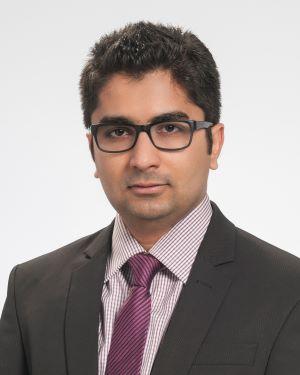
Balu Krishnan, PhD
Associate Staff
Associate Staff, Cleveland Clinic Epilepsy Center
Assistant Professor of Medicine, Cleveland Clinic Lerner College of Medicine of Case Western Reserve University
Director, SPIKE Lab
Email: [email protected]
Location: Cleveland Clinic Main Campus
Research
My research develops quantitative biomarkers of epileptogenic brain networks using computational modeling, electrophysiology and artificial intelligence. By integrating stereoelectroencephalography (SEEG), magnetoencephalography (MEG), electroencephalogram (EEG) and neuroimaging, my program aims to improve localization, treatment planning and outcome prediction for drug-resistant epilepsy. The work emphasizes clinically interpretable analytics that translate large-scale neural data into actionable tools for patient care.
Biography
Dr. Balu Krishnan is an Associate Staff member in the Cleveland Clinic Epilepsy Center, Assistant Professor of Medicine at Cleveland Clinic Lerner College of Medicine, and Director of the Signal Processing and Intelligent Knowledge Extraction in Epilepsy (SPIKE) Lab. His research focuses on developing computational and quantitative approaches to characterize epileptogenic brain networks and support data-driven clinical decision-making in epilepsy.
Dr. Krishnan’s work integrates engineering, neuroscience and clinical neurology by combining stereoelectroencephalography (SEEG), magnetoencephalography (MEG) scalp electroencephalogram (EEG), and neuroimaging with advanced signal processing and artificial intelligence methods. His research program aims to identify quantitative biomarkers of brain network organization, connectivity and seizure dynamics across invasive and noninvasive modalities.
As Director of the SPIKE Lab, Dr. Krishnan leads a multidisciplinary team of engineers, neurologists and neurosurgeons and oversees one of the largest curated SEEG repositories worldwide. His laboratory develops scalable computational pipelines and AI-based analytical frameworks designed to produce biologically interpretable and clinically deployable biomarkers for epilepsy.
Education & Professional Highlights
Education
Fellowship – Cleveland Clinic
Clinical Epilepsy
Cleveland, OH USA
2015
Graduate Education (PhD) – Arizona State University
Electrical Engineering
Tempe, AZ USA
2015
Graduate Education (Master of Science) – Arizona State University
Electrical Engineering
Tempe, AZ USA
2010
Undergraduate (Bachelor of Science) – College of Engineering Trivandrum
Electronics and Telecommunication Engineering
Thiruvananthapuram, India
2005
Professional Appointments
2024–Present: Associate Staff, Cleveland Clinic
2024–Present: Assistant Professor of Medicine, Cleveland Clinic Lerner College of Medicine
2017–2024: Adjunct Assistant Professor of Medicine, Cleveland Clinic Lerner College of Medicine
2015–2024: Research Associate Staff, Cleveland Clinic
2012–2015: Postdoctoral Research Fellow, Cleveland Clinic
Honors & Recognition
American Epilepsy Society Young Investigator Postdoctoral Research Fellowship
Cleveland Clinic Innovation Certificate of Recognition Patent: System and method for identifying abnormal brain network interactions
Provisional Patent: SEEG-Informer — Transformer-based AI model for epileptogenic zone localization
Professional Memberships
American Epilepsy Society (Member since 2012)
Research
Research Overview
The SPIKE Lab develops quantitative and computational methods to understand how pathological brain networks generate seizures. The program integrates large-scale clinical datasets with biophysical modeling and artificial intelligence to identify biomarkers that improve diagnosis, surgical planning and therapeutic monitoring. Research is tightly coupled with clinical workflows, enabling rapid translation of analytical discoveries into patient care applications.
Epileptogenic Network Modeling
We develop biophysically grounded models that infer physiological mechanisms directly from electrophysiological recordings.
Goals include:
- Characterizing network imbalance
- Identifying seizure onset network signatures
- Building patient-specific computational models
Large-Scale SEEG Biomarker Discovery
In close collaboration with clinicians and surgical teams, the SPIKE Lab contributes to the development and analysis of a large, curated stereoelectroencephalography (SEEG) dataset supporting quantitative biomarker research in epilepsy. This collaborative resource enables systematic investigation of epileptogenic networks across patients and clinical contexts.
Key efforts:
- Directional connectivity analysis
- Spatiotemporal seizure signatures
- Cross-patient biomarker validation
Artificial Intelligence for Clinical Translation
We develop machine learning and transformer-based models that convert high-dimensional neural recordings into clinically interpretable predictions.
Examples:
- SEEG-Informer AI model for epileptogenic zone localization
- Automated seizure detection algorithms
- MRI and EEG-based pathology detection
Selected Publications
Kumar Himanshu, Seshadri N P Guhan, Martinez David, Najm Imad, Alexopoulos Andreas, Bulacio Juan C, Serletis Demitre, Krishnan Balu. Three-Phase Seizure Segmentation in Stereotactic EEG Using Envelope-Based Multivariate Changepoint Analysis. Ann Biomed Eng. 2026. 41926031.
Banappa Hanu Skanda, Moura Tassia Ribeiro Salles, Serletis Demitre, Alexopoulos Andreas, Bulacio Juan, Krishnan Balu. Directional connectivity patterns in SEEG recorded epileptiform transitions in mesial temporal lobe epilepsy. J Neural Eng. 2026. 41861415.
Khoury Jean, Blümcke Ingmar, Busch Robyn M, Krishnan Balu, Bulacio Juan, Bingaman William, Serletis Demitre, Najm Imad. Deep characterization of refractory epilepsy due to mild malformation of cortical development with oligodendroglial hyperplasia (MOGHE) and insights into the role of invasive monitoring. Epilepsia. 2026. 41627170.
Chisholm Jason, Krishnan Balu, Khoury Jean, Alexopoulos Andreas, Bingaman William, Serletis Demitre, Najm Imad, Bulacio Juan C. Reply to "Semiology Timing and Seizure Patterns: Improving Surgical Decision-Making in Insular Epilepsy". Ann Neurol. 2026. 41439408.
Rabiul Islam M, Bulacio Juan C, Bingaman William, Najm Imad, Krishnan Balu, Serletis Demitre. Dynamic Stereoelectroencephalography-Based Phase-Amplitude Coupling in Cingulate Epilepsy. Int J Neural Syst. 2026. 41299200.
Chisholm Jason, Krishnan Balu, Khoury Jean, Alexopoulos Andreas, Bingaman William, Serletis Demitre, Najm Imad, Bulacio Juan C. Anterior Versus Posterior Insular Epilepsy: Correlations with Semiology Based on Stereoelectroencephalography. Ann Neurol. 2025. 40799141.
John Neha Sara, Bulacio Juan C, Alexopoulos Andreas V, Bingaman William, Najm Imad, Krishnan Balu, Serletis Demitre. Multifractal spatiotemporal dynamics in human epileptiform stereoelectroencephalography recordings. J Neural Eng. 2025. 40744072.
Shin Wanyong, Krishnan Balu, Nemani Ajay, Ontaneda Daniel, Lowe Mark J. Investigation of neuro-vascular reactivity on fMRI study during visual activation in people with multiple sclerosis using EEG and hypercapnia challenge. Med Phys. 2025. 40116356.
Krishnan Balu. The impact of radiofrequency thermocoagulation on brain connectivity in drug-resistant epilepsy: Insights from stereo-electroencephalography and cortico-cortical evoked potentials. Epilepsia. 2025. 39831797.
Nieto Ramos Alejandro, Krishnan Balu, Alexopoulos Andreas V, Bingaman William, Najm Imad, Bulacio Juan C, Serletis Demitre. Epileptic network identification: insights from dynamic mode decomposition of sEEG data. J Neural Eng. 2024. 39151464.
Su Ting-Yu, Choi Joon Yul, Hu Siyuan, Wang Xiaofeng, Blümcke Ingmar, Chiprean Katherine, Krishnan Balu, Ding Zheng, Sakaie Ken, Murakami Hiroatsu, Alexopoulos Andreas V, Najm Imad, Jones Stephen E, Ma Dan, Wang Zhong Irene. Multiparametric Characterization of Focal Cortical Dysplasia Using 3D MR Fingerprinting. Ann Neurol. 2024. 39096056.
Krishnan Balu, Taylor Kenneth, Wu Guiyun, Serletis Demitre, Najm Imad, Bulacio Juan, Alexopoulos Andreas V. Measurable transitions during seizures in intracranial EEG: A stereoelectroencephalography and SPECT study. Clin Neurophysiol. 2024. 38452427.
Kobayashi Katsuya, Taylor Kenneth N, Krishnan Balu, Mackow Michael J, Feldman Lauren, Bulacio Juan, Alexopoulos Andreas V, Najm Imad, Bingaman William, Nair Dileep R. Effective connectivity relates seizure outcome to electrode placement in responsive neurostimulation. Brain Commun. 2024. 38390255.
Krishnan Balu. Equipment Setup and Artifact Removal for Simultaneous Electroencephalogram and Functional Magnetic Resonance Imaging for Clinical Review in Epilepsy. J Vis Exp. 2023. 37427958.
Krishnan Balu, Wang Zhong Irene, Murakami Hiroatsu, Wu Guiyun, Burgess Richard, Najm Imad, Alexopoulos Andreas V. Novel noninvasive identification of patient-specific epileptic networks in focal epilepsies: Linking single-photon emission computed tomography perfusion during seizures with resting-state magnetoencephalography dynamics. Hum Brain Mapp. 2023. 36480260.
Tang Yingying, Blümcke Ingmar, Su Ting-Yu, Choi Joon Yul, Krishnan Balu, Murakami Hiroatsu, Alexopoulos Andreas V, Najm Imad M, Jones Stephen E, Wang Zhong Irene. Black Line Sign in Focal Cortical Dysplasia IIB: A 7T MRI and Electroclinicopathologic Study. Neurology. 2022. 35940890.
Choi Joon Yul, Krishnan Balu, Hu Siyuan, Martinez David, Tang Yinging, Wang Xiaofeng, Sakaie Ken, Jones Stephen, Murakami Hiroatsu, Blümcke Ingmar, Najm Imad, Ma Dan, Wang Zhong Irene. Using magnetic resonance fingerprinting to characterize periventricular nodular heterotopias in pharmacoresistant epilepsy. Epilepsia. 2022. 35343593.
Zawar Ifrah, Krishnan Balu, Mackow Michael, Alexopoulos Andreas, Nair Dileep, Punia Vineet. The Efficacy, Safety, and Outcomes of Brain-responsive Neurostimulation (RNS® System) therapy in older adults. Epilepsia Open. 2021. 34543516.