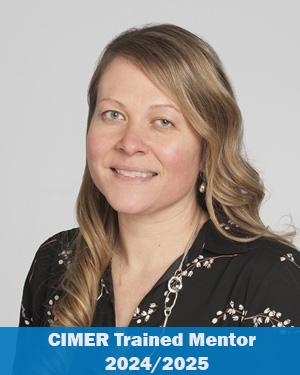
Michelle Longworth, PhD
Associate Staff
Email: [email protected]
Location: Cleveland Clinic Main Campus
Research
The disorganization of the genetic material (DNA) within cells can have dire consequences for the health of an organism, ultimately resulting in death or disease. We study the proteins that help to maintain DNA organization, and the ways by which they accomplish these important functions. We have discovered a novel role for several genome organizing proteins in repressing retrotransposon expression. Retrotransposons are DNA elements that can copy and paste themselves into new places in the genome and they make up 40% of the human genome. Therefore, the repression of retrotransposon expression and activity is very important to ensure genome integrity and cellular fitness. By studying the ways in which genome organizing proteins repress retrotransposons, we will gain a better understanding of how cells respond to various stresses to ensure the normal development and maintenance of tissues and uncover novel pathways that could be exploited to prevent disease progression. Currently, our lab has several projects focused on understanding the role of DNA organizing proteins and retrotranposon repression in patients with the neurodevelopmental disorder, Primary Microcephaly, as well as in patients with chronic inflammatory diseases including Crohn's Disease.
Biography
Dr. Longworth received her PhD from Northwestern University, where she studied Human Papillomavirus oncogenes and their interactions with chromatin regulators and tumor suppressor proteins in the laboratory of Dr. Laimonis Laimins. She then did her postdoctoral fellowship at the Mass General Hospital Cancer Center in the laboratory of Dr. Nicholas Dyson where she studied the regulation of chromatin organization and gene expression by retinoblastoma proteins and condensins. Dr. Longworth started her lab at the Lerner Research Institute in December of 2010. In addition to running the lab, Dr. Longworth is the Director of Staff Engagement in the LRI Faculty Center. In this role, Dr. Longworth works with the other members of the Faculty Center to develop and implement ideas to promote interactions, communication and collaboration among LRI staff members. Dr. Longworth is also the Director of the RISE in Cleveland program. This program provides local high school students with paid internships that allow them to gain experience and perform cutting edge research in the laboratories of the LRI during the summer.
Education & Professional Highlights
Education & Fellowships
Postdoctoral Fellowship- Massachusetts General Hospital Cancer Center (2005-2010)
Molecular Oncology
Charlestown, MA
Graduate School- Northwestern University Feinberg School of Medicine (2000-2005)
Integrated Graduate Program in the Biological Sciences, Cancer Biology Track
Chicago, IL
Undergraduate- Miami University of Ohio (1996-2000)
BA in Microbiology
Oxford, OH
"CIMER Trained Mentor" indicates the principal investigator has completed mentorship training based on curriculum from the Center for the Improvement of Mentored Experiences in Research, aimed at advancing mentoring relationships and promoting cultural change in research.
Research
Research Projects
Interplay between genome organizers and retrotransposable elements
Our lab discovered that condensin proteins repress retrotransposon expression and activity in both primary and transformed human cell lines (Ward et. al. PLOS Genetics, 2017) (Ward et. al. Nucleic Acids Research, 2022), as well as in vivo, in Drosophila melanogaster (Schuster et. al. PLOS Genetics, 2013). Current projects in the lab are now focused on understanding the signaling pathways that condensins (and other genome organizers) communicate with to facilitate repression, as well as the identification of novel mechanisms used by condensins and other genome organizing complexes to prevent retrotransposition.
Condensin-mediated regulation of neurodevelopment
Condensin protein mutations have been identified in microcephaly patients, however the mechanisms by which loss of condensin function leads to microcephaly are not well understood. We are using Drosophila melanogaster as a model organism as well as cortical organoids to uncover new roles for condensin proteins in neurodevelopment, with the ultimate goal of identifying new molecular pathways involved in the development of microcephaly (Crawford et. al. , Nature Communications, 2024). Conservation of these pathways will be then studied in mice and human cerebral organoids.
Antimicrobial roles for genome organizers
We discovered that condensin proteins are dysregulated in colonic epithelial cells of patients with a type of Inflammatory Bowel Disease (IBD) called ulcerative colitis. This led to the discovery that condensins possess antimicrobial functions in intestinal epithelial cells (Schuster et. al. Gastroenterology, 2015). Currently, we are collaborating with the Vachharajani, Scheraga, Wang, and Stappenbeck laboratories to understand whether condensins and other genome organizing proteins may be important for promoting innate immune signaling in both intestinal epithelial cells and monocytes in sepsis patients.
Exploring condensin induced intestinal permeability in vivo and in Crohn's Disease patient cells
Crohn's Disease is a type of Inflammatory Bowel Disease in which patients experience chronic, relapsing inflammation in the intestine. There is no cure, and patients often are or become resistant to treatment, with surgery left as the only option. Our lab has discovered that condensins are upregulated in intestinal epithelial stem cells of Crohn's Disease patients. We also found that the overexpression of condensin proteins induces senescence of intestinal stem cells which leads to their death, as well as the death of surrounding, non-stem cells in human, rat, and Drosophila melanogaster intestinal epithelial cells. This also leads to increased intestinal permeablity in vivo, in Drosophila melanogaster adults, at an early age. We are now investigating the mechanisms by which condensin protein overexpression causes senescence in vivo, with the goal of identifying conserved pathways that can be therapeutically targeted in patients.
Our Team
Selected Publications
Shrestha D, Pant BD, Roychowdhury S, Gandhirajan A, Cross E, Chhabria M, Bauer SR, Jeng M, Mitchell M, Mehkri O, Zaidi F, Ahuja A, Wang X, Wang Y, McDonald C, Longworth MS, Stappenbeck TS, Stark GR, Scheraga RG, Vachharajani V. Immunometabolic chaos in septic shock. J Leukoc Biol. 2025 Feb 13;117(2). doi: 10.1093/jleuko/qiae211. PubMed PMID: 39340428; PubMed Central PMCID: PMC11879763. Lechuga S, Marino-Melendez A, Davis A, Zalavadia A, Khan A, Longworth MS, Ivanov AI. Coactosin-like protein 1 regulates integrity and repair of model intestinal epithelial barriers via actin binding dependent and independent mechanisms. Front Cell Dev Biol. 2024;12:1405454. doi: 10.3389/fcell.2024.1405454. eCollection 2024. PubMed PMID: 39040043; PubMed Central PMCID: PMC11260685. Talley MJ, Longworth MS. Retrotransposons in embryogenesis and neurodevelopment. Biochem Soc Trans. 2024 Jun 26;52(3):1159-1171. doi: 10.1042/BST20230757. Review. PubMed PMID: 38716891; PubMed Central PMCID: PMC11346457. Bharti R, Dey G, Khan D, Myers A, Huffman OG, Saygin C, Braley C, Richards E, Sangwan N, Willard B, Lathia JD, Fox PL, Lin F, Jha BK, Brown JM, Yu JS, Dwidar M, Joehlin-Price A, Vargas R, Michener CM, Longworth MS, Reizes O. Cell surface CD55 traffics to the nucleus leading to cisplatin resistance and stemness by inducing PRC2 and H3K27 trimethylation on chromatin in ovarian cancer. Mol Cancer. 2024 Jun 10;23(1):121. doi: 10.1186/s12943-024-02028-5. PubMed PMID: 38853277; PubMed Central PMCID: PMC11163727. Crawford BI, Talley MJ, Russman J, Riddle J, Torres S, Williams T, Longworth MS. Condensin-mediated restriction of retrotransposable elements facilitates brain development in Drosophila melanogaster. Nat Commun. 2024 Mar 28;15(1):2716. doi: 10.1038/s41467-024-47042-9. PubMed PMID: 38548759; PubMed Central PMCID: PMC10978865. Padeken J, Longworth MS, Di Stefano L. Editorial: The epigenetic control of transposable elements in development and in diseases. Front Genet. 2023;14:1282449. doi: 10.3389/fgene.2023.1282449. eCollection 2023. PubMed PMID: 37732323; PubMed Central PMCID: PMC10507455.Ward JR, Khan A, Torres S, Crawford B, Nock S, Frisbie T, Moran JV, Longworth MS. Condensin I and condensin II proteins form a LINE-1 dependent super condensin complex and cooperate to repress LINE-1. Nucleic Acids Res. 2022 Oct 14;50(18):10680-10694. doi: 10.1093/nar/gkac802. PubMed PMID: 36169232; PubMed Central PMCID: PMC9561375.
Lechuga S, Cartagena-Rivera AX, Khan A, Crawford BI, Narayanan V, Conway DE, Lehtimäki J, Lappalainen P, Rieder F, Longworth MS, Ivanov AI. A myosin chaperone, UNC-45A, is a novel regulator of intestinal epithelial barrier integrity and repair. FASEB J. 2022 May;36(5):e22290. doi: 10.1096/fj.202200154R. PubMed PMID: 35344227; PubMed Central PMCID: PMC9044500.
Welch N, Singh SS, Kumar A, Dhruba SR, Mishra S, Sekar J, Bellar A, Attaway AH, Chelluboyina A, Willard BB, Li L, Huo Z, Karnik SS, Esser K, Longworth MS, Shah YM, Davuluri G, Pal R, Dasarathy S. Integrated multiomics analysis identifies molecular landscape perturbations during hyperammonemia in skeletal muscle and myotubes. J Biol Chem. 2021 Sep;297(3):101023. doi: 10.1016/j.jbc.2021.101023. Epub 2021 Jul 31. PubMed PMID: 34343564; PubMed Central PMCID: PMC8424232.
Yin S, Ray G, Kerschner JL, Hao S, Perez A, Drumm ML, Browne JA, Leir SH, Longworth M, Harris A. Functional genomics analysis of human colon organoids identifies key transcription factors. Physiol Genomics. 2020 Jun 1;52(6):234-244. doi: 10.1152/physiolgenomics.00113.2019. Epub 2020 May 11. PubMed PMID: 32390556; PubMed Central PMCID: PMC7311676.
Farabaugh KT, Krokowski D, Guan BJ, Gao Z, Gao XH, Wu J, Jobava R, Ray G, de Jesus TJ, Bianchi MG, Chukwurah E, Bussolati O, Kilberg M, Buchner DA, Sen GC, Cotton C, McDonald C, Longworth M, Ramakrishnan P, Hatzoglou M. PACT-mediated PKR activation acts as a hyperosmotic stress intensity sensor weakening osmoadaptation and enhancing inflammation. Elife. 2020 Mar 16;9. doi: 10.7554/eLife.52241. PubMed PMID: 32175843; PubMed Central PMCID: PMC7145421.
Deutschman E, Ward JR, Kumar A, Ray G, Welch N, Lemieux ME, Dasarathy S, Longworth MS. Condensin II protein dysfunction impacts mitochondrial respiration and mitochondrial oxidative stress responses. J Cell Sci. 2019 Nov 20;132(22). doi: 10.1242/jcs.233783. PubMed PMID: 31653782; PubMed Central PMCID: PMC6899004.
Ray G, Longworth MS. Epigenetics, DNA Organization, and Inflammatory Bowel Disease. Inflamm Bowel Dis. 2019 Jan 10;25(2):235-247. doi: 10.1093/ibd/izy330. Review. PubMed PMID: 30407525; PubMed Central PMCID: PMC6327229.
Deutschman E, Ward JR, Ho-A-Lim KT, Alban TJ, Zhang D, Willard B, Lemieux ME, Lathia JD, Longworth MS. Comparing and Contrasting the Effects of Drosophila Condensin II Subunit dCAP-D3 Overexpression and Depletion in Vivo . Genetics. 2018 Oct;210(2):531-546. doi: 10.1534/genetics.118.301344. Epub 2018 Aug 1. PubMed PMID: 30068527; PubMed Central PMCID: PMC6216582.
Kim Y, West GA, Ray G, Kessler SP, Petrey AC, Fiocchi C, McDonald C, Longworth MS, Nagy LE, de la Motte CA. Layilin is critical for mediating hyaluronan 35kDa-induced intestinal epithelial tight junction protein ZO-1 in vitro and in vivo. Matrix Biol. 2018 Mar;66:93-109. doi: 10.1016/j.matbio.2017.09.003. Epub 2017 Oct 1. PubMed PMID: 28978412; PubMed Central PMCID: PMC5845474.
Deutschman E, Longworth MS. New insights into the pRB/ Condensin II interaction. Cell Cycle. 2017 Oct 18;16(20):1859-1860. doi: 10.1080/15384101.2017.1360658. Epub 2017 Aug 18. PubMed PMID: 28820335; PubMed Central PMCID: PMC5638378.
Ward JR, Vasu K, Deutschman E, Halawani D, Larson PA, Zhang D, Willard B, Fox PL, Moran JV, Longworth MS. Condensin II and GAIT complexes cooperate to restrict LINE-1 retrotransposition in epithelial cells. PLoS Genet. 2017 Oct;13(10):e1007051. doi: 10.1371/journal.pgen.1007051. eCollection 2017 Oct. PubMed PMID: 29028794; PubMed Central PMCID: PMC5656329.
Alvarado AG, Thiagarajan PS, Mulkearns-Hubert EE, Silver DJ, Hale JS, Alban TJ, Turaga SM, Jarrar A, Reizes O, Longworth MS, Vogelbaum MA, Lathia JD. Glioblastoma Cancer Stem Cells Evade Innate Immune Suppression of Self-Renewal through Reduced TLR4 Expression. Cell Stem Cell. 2017 Apr 6;20(4):450-461.e4. doi: 10.1016/j.stem.2016.12.001. Epub 2017 Jan 12. PubMed PMID: 28089910; PubMed Central PMCID: PMC5822422.
Farabaugh KT, Majumder M, Guan BJ, Jobava R, Wu J, Krokowski D, Gao XH, Schuster A, Longworth M, Chan ED, Bianchi M, Dey M, Koromilas AE, Ramakrishnan P, Hatzoglou M. Protein Kinase R Mediates the Inflammatory Response Induced by Hyperosmotic Stress. Mol Cell Biol. 2017 Feb 15;37(4). doi: 10.1128/MCB.00521-16. Print 2017 Feb 15. PubMed PMID: 27920257; PubMed Central PMCID: PMC5288580.
Klebanow LR, Peshel EC, Schuster AT, De K, Sarvepalli K, Lemieux ME, Lenoir JJ, Moore AW, McDonald JA, Longworth MS. Drosophila Condensin II subunit Chromosome-associated protein D3 regulates cell fate determination through non-cell-autonomous signaling. Development. 2016 Aug 1;143(15):2791-802. doi: 10.1242/dev.133686. Epub 2016 Jun 17. PubMed PMID: 27317808; PubMed Central PMCID: PMC5004906.
Kemp JR, Longworth MS. Crossing the LINE Toward Genomic Instability: LINE-1 Retrotransposition in Cancer. Front Chem. 2015;3:68. doi: 10.3389/fchem.2015.00068. eCollection 2015. Review. PubMed PMID: 26734601; PubMed Central PMCID: PMC4679865.
Schuster AT, Homer CR, Kemp JR, Nickerson KP, Deutschman E, Kim Y, West G, Sadler T, Stylianou E, Krokowski D, Hatzoglou M, de la Motte C, Rubin BP, Fiocchi C, McDonald C, Longworth MS. Chromosome-associated protein D3 promotes bacterial clearance in human intestinal epithelial cells by repressing expression of amino acid transporters. Gastroenterology. 2015 Jun;148(7):1405-1416.e3. doi: 10.1053/j.gastro.2015.02.013. Epub 2015 Feb 18. PubMed PMID: 25701737; PubMed Central PMCID: PMC4446190.
Schuster AT, Sarvepalli K, Murphy EA, Longworth MS. Condensin II subunit dCAP-D3 restricts retrotransposon mobilization in Drosophila somatic cells. PLoS Genet. 2013 Oct;9(10):e1003879. doi: 10.1371/journal.pgen.1003879. Epub 2013 Oct 31. PubMed PMID: 24204294; PubMed Central PMCID: PMC3814330.
Aranjuez G, Kudlaty E, Longworth MS, McDonald JA. On the role of PDZ domain-encoding genes in Drosophila border cell migration. G3 (Bethesda). 2012 Nov;2(11):1379-91. doi: 10.1534/g3.112.004093. Epub 2012 Nov 1. PubMed PMID: 23173089; PubMed Central PMCID: PMC3484668.
Herr A, Longworth M, Ji JY, Korenjak M, Macalpine DM, Dyson NJ. Identification of E2F target genes that are rate limiting for dE2F1-dependent cell proliferation. Dev Dyn. 2012 Nov;241(11):1695-707. doi: 10.1002/dvdy.23857. Epub 2012 Sep 17. PubMed PMID: 22972499; PubMed Central PMCID: PMC3760379.
Longworth MS, Walker JA, Anderssen E, Moon NS, Gladden A, Heck MM, Ramaswamy S, Dyson NJ. A shared role for RBF1 and dCAP-D3 in the regulation of transcription with consequences for innate immunity. PLoS Genet. 2012;8(4):e1002618. doi: 10.1371/journal.pgen.1002618. Epub 2012 Apr 5. PubMed PMID: 22496667; PubMed Central PMCID: PMC3320600.
Black JC, Allen A, Van Rechem C, Forbes E, Longworth M, Tschöp K, Rinehart C, Quiton J, Walsh R, Smallwood A, Dyson NJ, Whetstine JR. Conserved antagonism between JMJD2A/KDM4A and HP1γ during cell cycle progression. Mol Cell. 2010 Dec 10;40(5):736-48. doi: 10.1016/j.molcel.2010.11.008. PubMed PMID: 21145482.
Manning AL, Longworth MS, Dyson NJ. Loss of pRB causes centromere dysfunction and chromosomal instability. Genes Dev. 2010 Jul 1;24(13):1364-76. doi: 10.1101/gad.1917310. Epub 2010 Jun 15. PubMed PMID: 20551165; PubMed Central PMCID: PMC2895196.
Longworth MS, Dyson NJ. pRb, a local chromatin organizer with global possibilities. Chromosoma. 2010 Feb;119(1):1-11. doi: 10.1007/s00412-009-0238-0. Epub 2009 Aug 28. Review. PubMed PMID: 19714354; PubMed Central PMCID: PMC3760338.
Longworth MS, Herr A, Ji JY, Dyson NJ. RBF1 promotes chromatin condensation through a conserved interaction with the Condensin II protein dCAP-D3. Genes Dev. 2008 Apr 15;22(8):1011-24. doi: 10.1101/gad.1631508. Epub 2008 Mar 26. PubMed PMID: 18367646; PubMed Central PMCID: PMC2335323.
Careers
Research News

Two investigators are combining their expertise to better understand protein CD55 and its role in chemoresistance.

The preclinical findings build on more than a decade of research into retrotransposable elements and their role in neural development.

With this funding, Drs. O’Connor and Longworth will investigate how host cells attempt to subvert human cytomegalovirus replication.