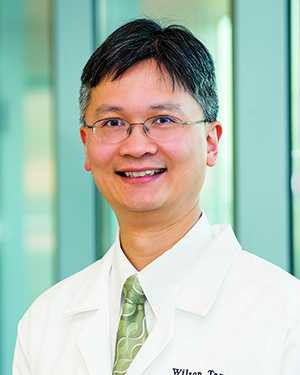
Wai Hong Wilson Tang, MD
Staff
Cardiovascular Medicine
Location: Cleveland Clinic Main Campus
Research
As a clinician-scientist, the goal of my research is to investigate mechanistic determinants of cardiovascular disease, particular in human heart failure and cardiomyopathy. One of the primary objectives is to understand the mechanisms to which genomic, immune, metabolic, and cellular processes promote disease progression, and the protective mechanisms that counteract these processes. The natural extension is to detect those at risk and intervene early, thereby preventing the development of heart failure and cardiomyopathy.
Biography
W. H. Wilson Tang, MD, is Research Director and staff cardiologist in the Section of Heart Failure and Cardiac Transplantation Medicine and Associate Section Head in the Section of Cardiovascular Genetics in the Sydell and Arnold Miller Family Heart, Vascular & Thoracic Institute at the Cleveland Clinic. Dr. Tang is Professor of Medicine at the Cleveland Clinic Lerner College of Medicine of Case Western Reserve University (CWRU) and holder of the Robert C. Tarazi, MD Endowed Chair in Heart and Hypertension Research.
Dr. Tang is a clinician-scientist interested in clinical translational research, with joint appointments with the Department of Heart, Blood, and Kidney Research at Cleveland Clinic Research. He leads the Cleveland Heart and Metabolic Prevention Study to investigate novel mechanisms in the development of heart diseases and co-leads the Cleveland GeneBank and BioBank Studies. Dr. Tang also has leadership role in the CWRU's Clinical and Translational Sciences Collaborative, overseeing the Resources and Services Module and the Clinical Research Unit at the Cleveland Clinic. Dr. Tang’s current research interests include the role of counter-regulatory mechanisms in the development and progression of heart failure, integrative genomics and epigenetics in cardiomyopathies, and metabolomics in heart-kidney physiology.
Dr. Tang has authored over 1,000 published peer-reviewed manuscripts in medical and scientific journals and chapters in medical textbooks (Scopus h-index 128). He currently serves in the Editorial Boards for Journal of the American College of Cardiology (JACC) Heart Failure, JACC Cardio-Oncology, Circulation Heart Failure, and American Heart Journal. He previously served as member of Board of Directors for Heart Failure Society of America (HFSA), and was elected as member of the American Society of Clinical Investigation in 2013 for his contributions to physiologic and mechanistic understanding of cardio-renal syndromes, as well as the Association of American Physicians in 2018 for invetigating the contributing role of diet and microbiome in human heart and kidney diseases. He has received the American College of Cardiology's 2022 Distinguished Scientist Award in the Basic Domain and the HFSA 2025 Pioneer Award for his scientific contributions to the field of heart failure and cardiomyopathy.
Education & Professional Highlights
Education & Fellowships
Fellowship - Cleveland Clinic
Advanced Heart Failure and Transplant Cardiology
Cleveland, OH USA
2004
Fellowship - Cleveland Clinic
Cardiovascular Medicine
Cleveland, OH USA
2003
Fellowship - Stanford University School of Medicine
Postdoctoral research fellowship
Stanford, CA USA
2000
Residency - Stanford University Medical Center
Stanford, CA USA
1999
Internship - Stanford University Medical Center
Internal Medicine
Palo Alto, CA USA
1997
Medical Education - Harvard Medical School
Boston, MA USA
1996
Undergraduate - Jesus College, Cambridge University
Natural Sciences (Part II Tripos)
Cambridge, United Kingdom
1992
Undergraduate - Brown University
Neural Sciences
Providence, RI USA
1992
Professional Highlights
- Professor of Medicine, Cleveland Clinic Lerner College of Medicine of Case Western Reserve University
- Robert C. Tarazi, MD, Endowed Chair in Heart and Hypertension Research
- Lead, NIH/NCATS Clinical and Translational Sciences Collaborative Resources and Services Module, Case Western Reserve University
- Research Director, Section of Heart Failure and Cardiac Transplantation Medicine, Sydell and Arnold Miller Family Heart, Vascular & Thoracic Institute at the Cleveland Clinic
- Medical Director, Clinical Research Unit, Cleveland Clinic Research, Cleveland Clinic
- Medical Director, Center for Cardiovascular Diagnostics and Prevention, Department of Heart, Blood and Kidney Research, Cleveland Clinic Research, Cleveland Clinic
Certifications
- Internal Medicine
- Internal Medicine - Cardiovascular Disease
- Internal Medicine - Advanced Heart Failure and Transplant Cardiology
Awards & Honors
- Fellow, American College of Cardiology, 2005
- Fellow, American Heart Association, 2006
- Elected member, American Society of Clinical Investigation, 2013
- 2016 Maria and Sam Miller Professional Excellence Award for Scientific Achievement in Clinical Research
- Fellow, Heart Failure Society of America, 2017
- Elected member, Association of American Physicians, 2018
- Sones/Favaloro Award Excellence in Research, 2019, 2025, 2026
- Cleveland Clinic Lerner College of Medicine Excellence in Research Education Award, 2025
- Heart Failure Society of America Pioneer Award, 2025
Innovations & Patents
- Research funding from National Institutes of Health (2010-present)
Memberships
- American College of Cardiology
- American Heart Association
- Heart Failure Society of America
- International Society of Heart and Lung Transplantation
- American Society of Clinical Investigations
- Association of American Physicians
Research
Human Translational Myocardial Disease Research Program
Dr. Tang’s research program is designed to address this gap by redefining cardiovascular disease through a precision, systems-based approachs, with the explicit goal of translating biological insight into earlier detection, improved risk stratification, and mechanism-guided intervention. The overall objective is to gain mechanistic insights into development and progression of heart failure and cardiomyopathy and translate into safe and efficacious precision therapeutics. Patients with similar clinical diagnoses often have different underlying mechanisms, disease trajectories, and responses to therapy. Our research seeks to understand these biological differences and translate that knowledge into more effective strategies for diagnosis, risk stratification, and treatment. Our laboratory combines prospective clinical studies, advanced cardiovascular phenotyping, molecular biology, genomics, biomarker discovery, and translational research to define the mechanisms that drive myocardial disease. By connecting patients, biospecimens, advanced molecular technologies, and pragmatic clinical trials within a learning health system, we aim to accelerate the development of precision cardiovascular therapies that improve outcomes for patients with heart failure, cardiomyopathy, and related diseases.
Program 1. Cardio-Immunology & Myocardial Recovery
Program 2. Cardio-Kidney-Metabolic Axis
Program 3. Cardio-Genomics & Molecular Regulation
Our Team
Selected Publications
View publications for Wai Hong Wilson Tang, MD
(Disclaimer: This search is powered by PubMed, a service of the U.S. National Library of Medicine. PubMed is a third-party website with no affiliation with Cleveland Clinic.)
Tang WH, Girod JP, Lee MJ, Starling RC, Young JB, Van Lente F, Francis GS. Plasma B-type natriuretic peptide levels in ambulatory patients with established chronic symptomatic systolic heart failure. Circulation. 2003; 108(24):2964-6.
Tang WH, Tong W, Troughton RW, Martin MG, Shrestha K, Borowski A, Jasper S, Hazen SL, Klein AL. Prognostic value and echocardiographic determinants of plasma myeloperoxidase levels in chronic heart failure. J Am Coll Cardiol. 2007; 49(24):2364-70.
Mullens W, Abrahams Z, Skouri HN, Francis GS, Taylor DO, Starling RC, Paganini E, Tang WH. Elevated intra-abdominal pressure in acute decompensated heart failure: a potential contributor to worsening renal function? J Am Coll Cardiol. 2008; 51(3):300-6.
Mullens W, Abrahams Z, Francis GS, Sokos G, Taylor DO, Starling RC, Young JB, Tang WHW. Importance of venous congestion for worsening of renal function in advanced decompensated heart failure. J Am Coll Cardiol. 2009; 53(7):589-596.
Tang WH, Francis GS, Morrow DA, Newby LK, Cannon CP, Jesse RL, Storrow AB, Christenson RH, Apple FS, Ravkilde J, Wu AH; National Academy of Clinical Biochemistry Laboratory Medicine. National Academy of Clinical Biochemistry Laboratory Medicine practice guidelines: Clinical utilization of cardiac biomarker testing in heart failure. Circulation. 2007; 116(5):e99-109.
Tang WH, Wang Z, Cho L, Brennan DM, Hazen SL. Diminished global arginine bioavailability and increased arginine catabolism as metabolic profile of increased cardiovascular risk. J Am Coll Cardiol. 2009; 53(22):2061-7.
Tang WH, Hartiala J, Fan Y, Wu Y, Stewart AF, Erdmann J, Kathiresan S; CARDIoGRAM Consortium; Roberts R, McPherson R, Allayee H, Hazen SL. Clinical and genetic association of serum paraoxonase and arylesterase activities with cardiovascular risk. Arterioscler Thromb Vasc Biol. 2012; 32(11):2803-12.
Tang WH, Wu Y, Hartiala J, Fan Y, Stewart AF, Roberts R, McPherson R, Fox PL, Allayee H, Hazen SL. Clinical and genetic association of serum ceruloplasmin with cardiovascular risk. Arterioscler Thromb Vasc Biol. 2012; 32(2):516-22.
Tang WH, Wang Z, Levison BS, Koeth RA, Britt EB, Fu X, Wu Y, Hazen SL. Intestinal microbial metabolism of phosphatidylcholine and cardiovascular risk. N Engl J Med. 2013; 368(17):1575-84.
Singh D, Shrestha K, Testani JM, Verbrugge FH, Dupont M, Mullens W, Tang WH. Insufficient natriuretic response to continuous intravenous furosemide is associated with poor long-term outcomes in acute decompensated heart failure. J Card Fail. 2014; 20(6):392-9.
Tang WH, Wang Z, Fan Y, Levison B, Hazen JE, Donahue LM, Wu Y, Hazen SL. Prognostic value of elevated levels of intestinal microbe-generated metabolite trimethylamine-N-oxide in patients with heart failure: refining the gut hypothesis. J Am Coll Cardiol. 2014; 64(18):1908-14.
Tang WH, Wang Z, Kennedy DJ, Wu Y, Buffa JA, Agatisa-Boyle B, Li XS, Levison BS, Hazen SL. Gut microbiota-dependent trimethylamine N-oxide (TMAO) pathway contributes to both development of renal insufficiency and mortality risk in chronic kidney disease. Circ Res. 2015; 116(3):448-55.
Nagatomo Y, McNamara DM, Alexis JD, Cooper LT, Dec GW, Pauly DF, Sheppard R, Starling RC, Tang WH; IMAC-2 Investigators. Myocardial Recovery in Patients With Systolic Heart Failure and Autoantibodies Against β1-Adrenergic Receptors. J Am Coll Cardiol. 2017; 69(8):968-977.
Li W, Kennedy D, Shao Z, Wang X, Kamdar AK, Weber M, Mislick K, Kiefer K, Morales R, Agatisa-Boyle B, Shih DM, Reddy ST, Moravec CS, Tang WHW. Paraoxonase 2 prevents the development of heart failure. Free Radic Biol Med. 2018; 121:117-126.
Liu CF, Abnousi A, Bazeley P, Ni Y, Morley M, Moravec CS, Hu M, Tang WHW. Global analysis of histone modifications and long-range chromatin interactions revealed the differential cistrome changes and novel transcriptional players in human dilated cardiomyopathy. J Mol Cell Cardiol. 2020; 145:30-42
Mohan ML, Nagatomo Y, Saha PP, Mukherjee SD, Engelman T, Morales R, Hazen SL, Tang WHW, Naga Prasad SV. The IgG3 subclass of β1-adrenergic receptor autoantibodies is an endogenous biaser of β1AR signaling. Mol Biol Cell. 2021; 32(7):622-633.
Liu CF, Ni Y, Moravec CS, Morley M, Ashley EA, Cappola TP, Margulies KB, Tang WHW. Whole-Transcriptome Profiling of Human Heart Tissues Reveals the Potential Novel Players and Regulatory Networks in Different Cardiomyopathy Subtypes of Heart Failure. Circ Genom Precis Med. 2021; 14(1):e003142.
Tang WHW, Nemet I, Li XS, Wu Y, Haghikia A, Witkowski M, Koeth RA, Demuth I, König M, Steinhagen-Thiessen E, Bäckhed F, Fischbach MA, Deb A, Landmesser U, Hazen SL. Prognostic value of gut microbe-generated metabolite phenylacetylglutamine in patients with heart failure. Eur J Heart Fail. 2024; 26(2):233-241.
Kodur N, Gunsalus P, Milinovich A, Dalton JE, Tang WHW. Prognostic Value of Natriuretic Peptide Levels in Heart Failure With Recovered Ejection Fraction. Circ Heart Fail. 2025; 18(11):e013386.
Research News

Cleveland Clinic researchers have uncovered how anthracycline induces heart damage in humans and developed a proof-of-concept strategy to protect cancer patients’ hearts.

Four principal investigators share what they are studying and why they believe Cleveland Clinic is the best place for heart research—and patient care.

Recent cardiovascular research at Cleveland Clinic examined topics such as the gut microbiome connection to the heart, COVID-19’s impact on cardiac event risk and improving cardiac imaging.

W.H. Wilson Tang, MD discusses the importance of metabolite research in maintaining health and what researchers have yet to discover.